
Fine for chemical company after worker suffers burns
A chemical company has been fined £100,000 after one of its workers was permanently scarred from burns from a steam hose at a site in Motherwell.
A 23-year-old was burnt across his back and other areas of his body as he attempted to clean a process water tank on 23 October 2019. At the time he had been working for Dundas Chemical Company (Mosspark) Limited at its site at Omoa Works in Newarthill for around two years.
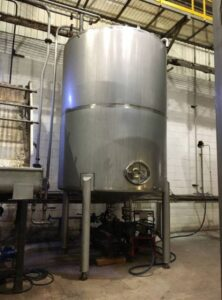
The company operates a large rendering plant that processes animal waste and food industry waste to produce proteins, fats and oils used in the oleo chemical, fuel, and feed industries. As a result of this process, the water tank and vickery would need occasional cleaning. The process water tank is shown in the image below:
It was during a nightshift that the man had been instructed to undertake cleaning duties on the process water tank, the vickery and the walls and floors in that area. The company provided pressure washers as well as a steam hose for cleaning down difficult areas where there may be tallow or other animal residues.
The steam hose was heavy and cumbersome to manoeuvre, with the uninsulated nozzle also becoming hot.. The man and a colleague therefore took it in turns to carry out the steam hose task.
After a period of time they stopped to have a break. While his colleague then went on to carry out other duties, the 23-year-old proceeded to finish the cleaning on his own.
He did this with the aid of a small cherry picker – attaching the steam hose to its basket. After the basket had been raised to the required height, the steam hose and nozzle spun round and steam began flowing into the cherry picker basket directly at him. He quickly turned his back to prevent his face being burned, while manipulating the nozzle of the hose away from him and lowering the basket of the cherry picker, at which point he was then able to run through to one of the deluge showers to cool his burn injuries. He was taken to hospital with steam burns to several parts of his body, which have left scars to this day.
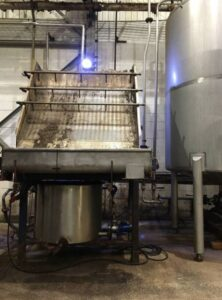
The vickery at the site
An investigation carried out by the Health and Safety Executive (HSE) found the nozzle fitted to the steam hose was unsafe as it did not have a trigger or other mechanism fitted to allow the operator to start or stop the flow out of the nozzle at the point of operation. It also found that the mixing valve and set-up for supplying hot water for cleaning purposes was not maintained in an efficient working order or in good repair. Supervisors at the site were aware that the mixing valve was passing steam, however no action was taken to investigate the issue or prevent it from happening..
HSE inspectors also found the maintenance and engineering team had no sound engineering understanding of the risks involved when setting up such a washdown system and how to mitigate or control those risks. The company provided information to HSE that there were no records associated with the maintenance of the valve, hose or nozzle.
Dundas Chemical Company (Mosspark) Limited, of Mosspark, Brasswell, Dumfries, pleaded guilty to breaching section 2(1) of the Health and Safety at Work etc Act 1974. It was fined £100,000 at Hamilton Sheriff Court on 18 August 2025.
HSE inspector Ashley Fallis said: “Had a safe system of work been in place then this incident would not have happened.“The lack of appropriate risk assessment, method statements, training and supervision for both the maintenance team who installed the valve, and the operators tasked with using the system, led to a situation where those involved were unaware of risks or simple control measures.
“This catalogue of failures resulted in a young man sustaining very serious burns, to which he still bears the scars to this day.
“We will not hesitate to take action against companies that fail to protect their employees.”
See the HSE linkGeneral Introduction to the EU Machinery Regulation (EU) 2023/1230
The EU Machinery Regulation (EU) 2023/1230 is the new legal framework governing the design, manufacture, and placing on the market of machinery within the European Union. It replaces the former Machinery Directive 2006/42/EC and is intended to address technological developments such as digitalization, automation, artificial intelligence, and connected machinery.
The Machinery Regulation becomes fully enforced from 20 January 2027.
Objectives of the Regulation
In addition to provide legal certainty and consistent requirements across all EU Member States and facilitate the free movement of machinery within the EU Single Market, the Machinery Regulation also aims to:
- Ensure a higher level of health and safety protection for users of machinery.
- Address new risks arising from software, AI, cybersecurity, and connected products.
Scope
The Regulation covers machinery and related products as follows placed on the EU market or put into service within the EU,
- Safety components
- Partly completed machinery
- Removable mechanical transmission devices
- Lifting accessories
- Chains, ropes, and webbing used for lifting
Major differences
The new legal framework changes from the Machinery Directive to Regulation which means that the Regulation shall be directly applicable to all EU members rather than to be concerted to national regulations before implementation. The Regulation defines some new requirements relating to:
1. Digital Documentation
Manufacturers may provide instructions and technical documentation in digital form, subject to certain conditions rather than the hard copy only.
2. High-risk Machinery
The Regulation defines high-risk machinery in its Annex I which previously were included in the Annex IV in the Machinery Directive. However, the Regulation categorized the machineries into two groups, e.g. Group A and Group B. Whare as the Group A machinery require enhanced conformity assessment procedures involving notified bodies.
3. Additional Risks
The Annex 3 of the Regulations require the follow risks shall be evaluation if these risks are related to the safety function of a machine:
- Cybersecurity
Machinery must be protected against malicious actions that could affect safety functions. - Artificial Intelligence
Safety assessments must consider adaptive and self-learning systems where they impact machinery safety. - Remote Updates
Software modifications and updates that affect safety must be controlled and documented.
Compliance Steps
- Complete conformity assessment procedure.
- Issue an EU Declaration of Conformity.
Important message
If you are placing machinery on the EU market before 20 January 2027, you must still CE mark it in accordance with the Machinery Directive 2006/42/EC, because the Machinery Regulation (EU) 2023/1230 does not become generally applicable until 20 January 2027
Please feel free to contact us for any further information about the Machinery Regulation.
General Introduction to the New EU Construction Products Regulation (CPR 2024)
The European Union has replaced its previous Construction Products Regulation (CPR 2011) with a new framework: Regulation (EU) 2024/3110, commonly referred to as CPR 2024. The regulation was adopted in November 2024, entered into force on 7 January 2025, and is being implemented through a phased transition beginning from 8 January 2026. It repeals and gradually replaces the former CPR (EU) No. 305/2011.
Objectives
The CPR2024 establishes harmonized rules for marketing construction products across the EU. In addition to improve transparency and comparability of product performance and ensure the free movement of construction products within the EU single market, It also aims to :
- Strengthen safety requirements.
- Support the EU's green and digital transitions.
- Promote circular economy principles and sustainability in construction.
Scope
The regulation applies to construction products that are intended to be permanently incorporated into buildings or civil engineering works, including:
- Traditional construction materials (cement, steel, insulation, windows, etc.).
- Certain key components and parts.
- Some materials used in construction products.
- 3D-printed construction products.
- In some cases, used construction products.
Major Changes
1. Sustainability Requirements
One of the most significant changes is the increased focus on environmental performance. Manufacturers will need to provide more detailed information about:
- Environmental impacts across the product life cycle.
- Resource efficiency.
- Circularity and recyclability.
- Carbon footprint and sustainability characteristics.
2. Digital Product Passport (DPP)
The new CPR introduces the possibility of a Digital Product Passport, which will make product information more accessible through digital tools.
The DPP is intended to provide:
- Technical performance data.
- Compliance information.
- Environmental information.
- Product traceability details.
This supports greater transparency throughout the construction value chain.
3. Improved CE Marking Framework
CE marking remains central to demonstrating compliance with EU requirements, but CPR 2024 strengthens the underlying rules by:
- Improving conformity assessment procedures.
- Enhancing market surveillance.
- Clarifying manufacturer responsibilities.
- Linking declarations more closely to verified performance and sustainability data.
4. Declaration of Performance and Conformity
Manufacturers will continue to provide performance information, but CPR 2024 expands this concept through a combined framework covering:
- Product performance.
- Regulatory conformity.
- Environmental information.
The goal is to provide more reliable and comparable information to regulators, specifiers, contractors, and end users.
5. More Flexible Standardization System
CPR 2011 faced criticism because the development of harmonized standards was often slow. The new regulation gives the European Commission additional mechanisms to:
- Develop common specifications when standardization is delayed.
- Respond more quickly to technological innovation.
- Support emerging construction technologies and products.
Implementation Timeline
| Date | Milestone |
|---|---|
| 27 Nov 2024 | CPR 2024 adopted |
| 18 Dec 2024 | Published in the Official Journal of the EU |
| 7 Jan 2025 | Entered into force |
| 8 Jan 2026 | Start of phased application |
| 2026 onward | New harmonized technical specifications gradually introduced |
Importantly, products do not automatically fall under the new CPR immediately. Product families transition to CPR 2024 as new harmonized technical specifications are adopted.
Please feel free to contact us for further information on the CPR 2024.